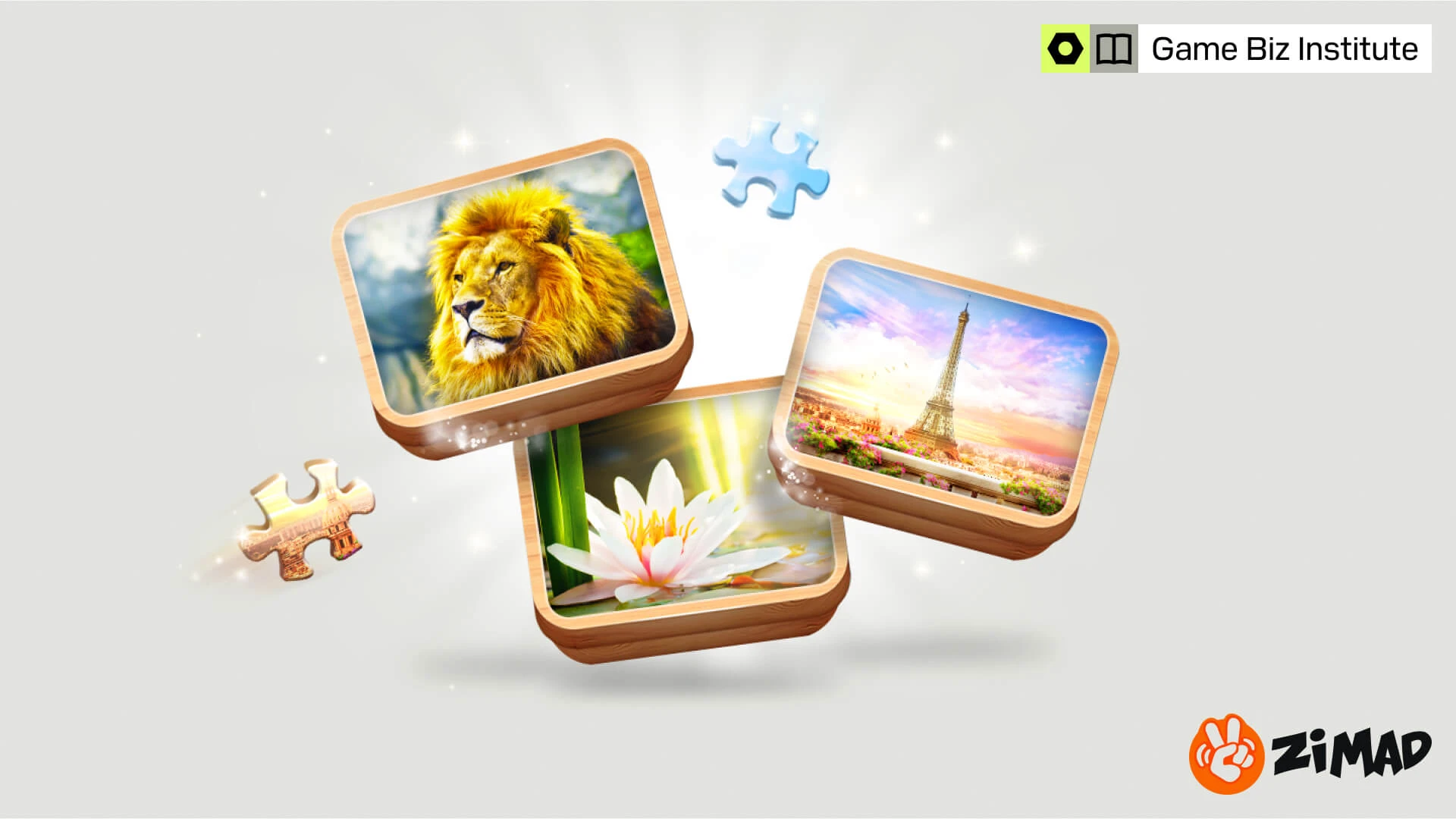
After 15 years and 170M downloads of Magic Jigsaw Puzzles, ZiMAD's Chief BD Officer shares how to protect player trust and lead through fast change.
For me, good business development always starts with trust. Trust between our partners and us. Trust between the game and its players. The value of a partnership is not just revenue or reach. It is whether the deal makes the brand stronger and the game better, without breaking what made it special in the first place.
Hi, I'm Elizaveta Savenkova, Chief Business Development Officer at ZiMAD (Magic Jigsaw Puzzles), where I build partnerships that protect a game millions of players trust.
ZiMAD has worked with Disney, Marvel, and National Geographic. We have partnered with ZeptoLab and with environmental groups like Evertreen. That is an unusual range for a puzzle game, and people often ask how we choose. The answer is simple. Before any deal, I ask one question: What will our players think?
Players Are the Focus
It is incredible to think that I was there when Magic Jigsaw Puzzles celebrated its 10th anniversary. Today, it is 15 years old. On mobile, that kind of lifespan is rare. Most games never reach it.
When you run business development for a game this old, the job changes. With a new product, you have more room to experiment. You can try things, fail, and try again. With a game that players have loved for more than a decade, every choice carries more weight. You are not only chasing growth. You are protecting a brand that millions of people know and trust.
That responsibility shapes everything I do. So I want to share a few honest lessons from the work, in case they help you protect what you are building, too.
A famous brand is exciting. A partnership that makes headlines feels good. But if it does not connect with the people playing the game, it will not create real results. We spend a lot of time learning what our audience cares about, what they enjoy, and what content pulls them in. If a partnership fits that, it is worth exploring. If it only looks good in a press release, it is a distraction.
I cannot share the commercial details of any deal. What I can tell you is that the real cost is not the money.
When you work with a globally known brand, you have to protect the legacy of both partners. You have to find the balance between their brand values and your own product vision. That takes work across many teams at once, from product and art to legal, marketing, and operations. It takes patience. These deals are heavy. But when both sides share the same goals and respect each other's strengths, they create something players love and everyone benefits from. That is the version worth pursuing.
The approval process is also a production risk, not just that it takes effort, but that licensor approval timelines are often outside your control and can directly affect your roadmap. For a franchise with years of player loyalty, recognition alone is not enough. In some calses, the IP needs a world that translates naturally into gameplay, and ideally, a direction that aligns with where the IP owner is already heading. The most common mistake I see is moving before both sides are truly aligned. When the goals are different and nobody surfaces that early, the pressure shows up later in approvals, in creative direction, in timelines. By then it costs much more to fix. Get aligned at the start.
The Old Playbooks Stopped Working
I am currently reading a book about AI that was published in 2025. A year ago, many companies were still trying to adapt to new acquisition channels, changing platform dynamics, and the rapid rise of AI. Today, some of the assumptions we had then already feel outdated.
The biggest lesson for me has been that adaptability matters more than certainty. The companies that succeed are not necessarily the ones with the best long-term predictions. They are the ones who can learn quickly, test efficiently, and adjust their strategy as the environment changes. In today's market, moving too slowly can be more dangerous than making the wrong prediction.
We are living through one of the fastest periods of change I have seen in my career.
Why Trust Grows More Valuable, Not Less
Some partnerships take months. Others take years. Leaders often push for faster returns, and good ones should. Part of the job is knowing where you need quick results and where patience creates far more value later. But you cannot rush trust.
Trust is one of the most valuable assets in business, and it cannot be built overnight.
I do not build partnerships around single transactions. The strongest relationships are built on credibility, consistency, and shared goals. And here is something I find interesting. As AI takes over more routine work, human relationships may become even more valuable. Technology helps us move faster. Trust, reputation, and real connection are still very hard to copy.
Doing Good When No One Is Watching
ZiMAD has joined sustainability efforts such as Playing for the Planet and Evertreen. People ask if that is a real strategy or just good public relations.
For us, it starts with values. Giving back is one of our core principles. Some of our efforts show up in partnerships and in the game itself. We don't promote many of our charitable activities. Positive impact can indeed help a brand, but I believe the most meaningful work is the kind you would still do if nobody ever saw it.
The Hardest Part of Becoming a Leader
If you are stepping into a leadership role, here is the mistake I see most often. People struggle to stop doing the hands-on work themselves.
A leader's job is to set direction, use resources well, support the team, and make decisions that move the business forward. When you spend too much time controlling every detail, you become the bottleneck. Decisions slow down. Your team loses room to act. Good chances slip by. Strong leaders get more done through their people, not by doing everything alone.
One Prediction for the Next 18 Months
I have learned to be careful with confident predictions. But if I have to make one, here it is.
Within 18 months, AI tools will be standard in most casual gaming studios.
It will be unusual to find a team that is not using AI in some real part of its creative, operational, or production work. The studios that treat it as normal, rather than fight it, will move faster than the rest.
The Partnership I Am Proud Of
People expect me to name a famous brand here. I will not. The partnership I value most is the one inside our own team. When talented people trust each other, challenge each other, and work toward the same goal, that becomes the base for every good deal we make outside the company. Get that right, and the rest gets easier.
Moral of the Story
If you take one thing from 15 years of this work, let it be this. Protect the trust your players give you. Build partnerships that serve them first. Stay ready to change, and use the new tools as they arrive. But the relationships you build are what last.
The tools will keep changing. Trust is the asset that holds.
When you are ready to grow your own game, the right partners can quietly handle the hard parts in the background, so that you can stay focused on play. Xsolla is one of the companies working to provide developers with all the things a game needs to launch, grow, and reach more players. Wherever you build from here, keep your players at the center. They are the real heroes of this story.
Interviews, copywriting, editing, and article publication prepared by Kirill Tokarev, Lisa Sirlin-Hall, Viktoria Steshina, and David Jagneaux.
Talk with an Xsolla expert
Learn how Xsolla’s video game monetization experts can help accelerate your business. Xsolla is a global video game commerce company with a robust set of tools and services designed specifically for the game industryLearn how Xsolla’s video game monetizationexperts can help accelerate your business. Xsolla isa global video game commerce company with arobust set of tools and services designedspecifically for the game industry.
By submitting this form, you consent to receive the digital guide.You can unsubscribe at any time. For more information, please read our Privacy Policy.
How to solve the investment problem for mid-tier AA games
Shawn Layden is building a financing vehicle for stranded AA games. The teams keep their IP. The hard part is that nobody knows how to underwrite a video game.
Brian CrecenteEditorial consultant to the video game industry
SEPTEMBER 14, 20266 MIN
Proactive, not reactive: 24 years of keeping games online
The calm game launch is never luck; it's the result of work you do long before release day.
The players you already have are your biggest growth opportunity
Adikteev's Emilien Eychenne knows that your biggest game growth lever isn't new installs; it's learning to spot churn early and win mobile players back for good.
The trust gap: why Asian players abandon your checkout
Xsolla research across Asia reveals a consistent pattern: players do not abandon carts because of price; they leave because the checkout feels foreign. Here is what it takes to earn trust at the moment of purchase.
How game discovery actually works, and fails, in 2026
Distribution got democratized. Discoverability got concentrated. GAM3S.GG Head of Operations Eliza Crichton-Stuart speaks out on what that gap means for players and developers, and how to close it.
Virtual worlds were supposed to let players be themselves, but monetization forgets that
MUD1 co-creator Richard Bartle reflects on the origins of virtual worlds, the player-developer contract, free-to-play, pay-to-win, Web3, and why lasting MMOs need purpose before monetization.
Richard BartleGame Design Professor, University of Essex
AUGUST 13, 20266 MIN
What 15 years of game partnerships taught me
After 15 years and 170M downloads of Magic Jigsaw Puzzles, ZiMAD's Chief BD Officer shares how to protect player trust and lead through fast change.
GDAI's Program Director, Machaiah Kalengada, dives into the unique combination of India's 550 million young gamers and an industry ready to build its own IP. He reveals what's really happening in India's booming game development scene.
Andrew Naicker of Skystone Games has spent 14 years watching the "ship faster, market louder" playbook fail. Here's what he actually builds and what it takes to launch in 2026.
Entertainment licensing isn't a AAA-only game anymore. Xsolla Agency global IP licensing advisor Mark Caplan discusses how mobile studios are sitting on one of the best growth levers in the industry and most aren't using it. Here's what developers get wrong and how the right partner changes everything.
Mark CaplanGlobal IP licensing advisor, Xsolla Agency
AUGUST 13, 20269 MIN
The attention economy: how games win mind share in 2026
Players have more to watch, play, and scroll through than ever. They have less time to give any of it. Lexi Sydow, founder of The ATTN Economy, explains why that gap is the real battleground for every game in 2026.
Lexi SydowChief Analyst & Founder, The ATTN Economy
AUGUST 13, 20266 MIN
What keeps a game running for 24 years?
Sega's head of development studios on LiveOps, global growth, and going direct to players.
Are you a game industry expert with insights that inform? Help us grow Game Business Institute and earn revenue for contributions that have direct impact.
Game Biz Institute
The game industry's most extensive library of business insights.





.jpg)
.png)
.jpg)
-808x789.webp)
-1920x1080.webp)
-1920x1080.webp)

-1920x1080.webp)

-1920x1072.webp)
-1-400x400-400x400.webp)
-501x501.webp)

-500x500.webp)


-800x800.webp)
-2-1920x1920.webp)