Adikteev's Emilien Eychenne knows that your biggest game growth lever isn't new installs; it's learning to spot churn early and win mobile players back for good.
You pay good money to acquire a new player. Their activity reveals details about them, and you have every opportunity to monetize them. Unfortunately, most games let that player walk out the door without any marketing follow-up.
I have spent more than thirteen years building mobile re-engagement and retargeting platform Adikteev, and almost as long investing in gaming, adtech, and AI companies. Running one company teaches you how to survive inside a single set of constraints. Watching twenty companies at once teaches you how many different ways there are to win. One lesson keeps coming back to me: Most teams pour their energy into the top of the funnel and accept the leak at the bottom. That leak is where the real opportunity lives.
Here is a factor most people don't know: a returning player costs less to reach, arrives with higher intent, and comes with a track record you can actually learn from. Even the smallest leak can sink a large ship over time.
Retargeting is underused because it is less glamorous than hacking growth through new installs. However, the math is in your favor once you put in real effort. Remember that you are not chasing a stranger; you are doubling down on someone whose value you have already measured.
A returning player costs less to reach, arrives with higher intent, and comes with a track record you can actually learn from.
Churn is a slope, not a cliff
The decision to leave is usually made before a player even opens your app. That's what makes churn so hard to predict in a live game: wait for the obvious signal, and you're already too late.
The signals that matter show up early and quietly: sessions get shorter, the gap between sessions stretches out, and the player starts skipping the parts of the loop they used to love. Spending slows and progress stalls. In a mobile game, the window that decides everything is often the first few days, and the moment right after a hard difficulty or content wall.
Properly monitored, you can see disengagement forming days before a player consciously quits, while there is still a live relationship to act on. The hard part is not deducing who left; it is spotting who is about to leave, early enough that a thoughtful nudge still lands.
Value and the sales funnel fallacy
Retention is one of the hardest problems in games, and for a structural reason: your product has to earn attention every single session against endless alternatives. There is no lock-in, no switching cost, and no work reason to come back. That’s why day 1, day 7, and day 30 numbers fall off a cliff. Most of those players were never going to stay. You are planning for the few who will.
The usual killers are the same across studios. Onboarding that does not deliver the core fun fast enough. Difficulty spikes that feel like punishment. Long stretches with nothing new to pull a player back.
The biggest missed opportunity is not acquiring more players; it is the wavering player in the middle of the funnel who had one bad session and is quietly drifting away. That player is still reachable, but most studios simply do not look.
Bring players back for a reason, not with a bribe
There is a real difference between reaching a player at the right moment with the right message and yanking them back in a way that does not stick. An artificial win-back, a generic push, or a bribe buys you one session and a nice bump on the dashboard. Then the same churn returns, this time with a slightly more annoyed player.
Durable re-engagement starts with why this specific person disengaged, and meets them at a moment that genuinely matters to them. At Adikteev, we spend a lot of time understanding the data before we launch anything, because a well-informed campaign beats a rushed one every time.
There is always going to be a level of estimation and error in the new world. You have to become comfortable with that and understand, ‘Is this campaign contributing, on the whole, as a net gain to my revenue?’
And for measuring win-back campaigns, there are many details to the exact methods, but you should be able to see a cohort of users before you ran your win-back campaign and after. Then estimate the lift based on their revenue/LTV trajectory before the campaign was run. To increase your confidence, you can hold back part of that targeting campaign as a control group. You can use that group to say, ‘This is the revenue I would have driven if no retargeting campaign was run.’ Then measure the uplift of the test group against that baseline.
If you measure success by "did they open the app once," you are optimizing for spikes.
The metric you choose shapes the campaign you build. Judge yourself on downstream retention and long-term value from the players you bring back, and you are forced to reconnect them to what they enjoyed. We pilot on return on ad spend, and we are quick to pause anything that is not working, though we never judge results on day one alone. The real test is not whether a player returns; it is whether they are still there weeks, or even months, later.
What ATT changed, and what it did not
The end of easy user-level tracking hit our industry hard. App Tracking Transparency removed the stable identifier that retargeting had quietly been built on. It forced us to rethink our whole approach.
What we rebuilt was the layer underneath. We moved from following a single identified person to using privacy-safe signals, aggregated measurements, and modeling. In practice, retargeting became less about "I know exactly who this is" and more about "I can identify the right player and the right moment with high confidence." The teams that survived did not chase loopholes to recreate the old world. They rebuilt on first-party data, context, and better models. Our own answer was a proprietary ID layer that recognizes users without the old advertising identifier with about eighty percent confidence, which is more than enough to make retargeting them worthwhile.
Instead of one single ID (IDFA before ATT), it’s now relying on many different probabilistic signals like IP, device model, timestamps, etc. Then it’s up to the network and MMP that you’re working with on how sophisticated their modeling is to make a confident connection between these different signals and a known user.
Where AI helps, and where judgment still wins
AI is genuinely changing what is possible in prediction and personalization. It reads the subtle disengagement signals, decides who to reach and when, and tailors campaigns at a scale no human team could match. Generative tools now speed up creative work and free people from low-value manual tasks, allowing them to focus on what matters most: the relationship with the client and the player.
But AI is not ready to define strategy. It does not understand what a healthy, long-term relationship with a player actually looks like. It is great for fast, creative testing, but still short on generating the ideas that truly move people to come back.
The winning setup is AI doing the analysis and the short-term optimization, and human judgment defining what "good" means.
Re-engagement needs a predictive system
Privacy rules keep tightening, but the pace has slowed. Google has delayed removing its advertising ID, and the big platforms are under legal pressure over how they enforce these rules. I do not expect dramatic shifts on that front soon.
The bigger change is that AI keeps narrowing the gap between predicting churn and responding to it. Re-engagement is becoming real-time and personal rather than a set of separate campaigns. Players will tolerate less spam and reward genuine relevance more sharply. So the discipline moves away from retargeting as a tactic and toward retention as an always-on, predictive system that lives close to the product itself.
That shift rewards studios that treat retention as a system with signals and feedback loops, rather than a series of blasts. Gaming taught me that discipline, and it is the most portable thing I carry into every other category I work in.
If you struggle with re-engagement, it helps to have partners who quietly handle the parts that keep a game running and growing, so your team can stay focused on the fun.
That is the spaceXsolla works in, with all the things a studio needs to launch, grow, and keep players coming back.
Interviews, copywriting, editing, and article publication prepared by Kirill Tokarev, Lisa Sirlin-Hall, Viktoria Steshina, and David Jagneaux.
Talk with an Xsolla expert
Learn how Xsolla’s video game monetization experts can help accelerate your business. Xsolla is a global video game commerce company with a robust set of tools and services designed specifically for the game industryLearn how Xsolla’s video game monetizationexperts can help accelerate your business. Xsolla isa global video game commerce company with arobust set of tools and services designedspecifically for the game industry.
By submitting this form, you consent to receive the digital guide.You can unsubscribe at any time. For more information, please read our Privacy Policy.
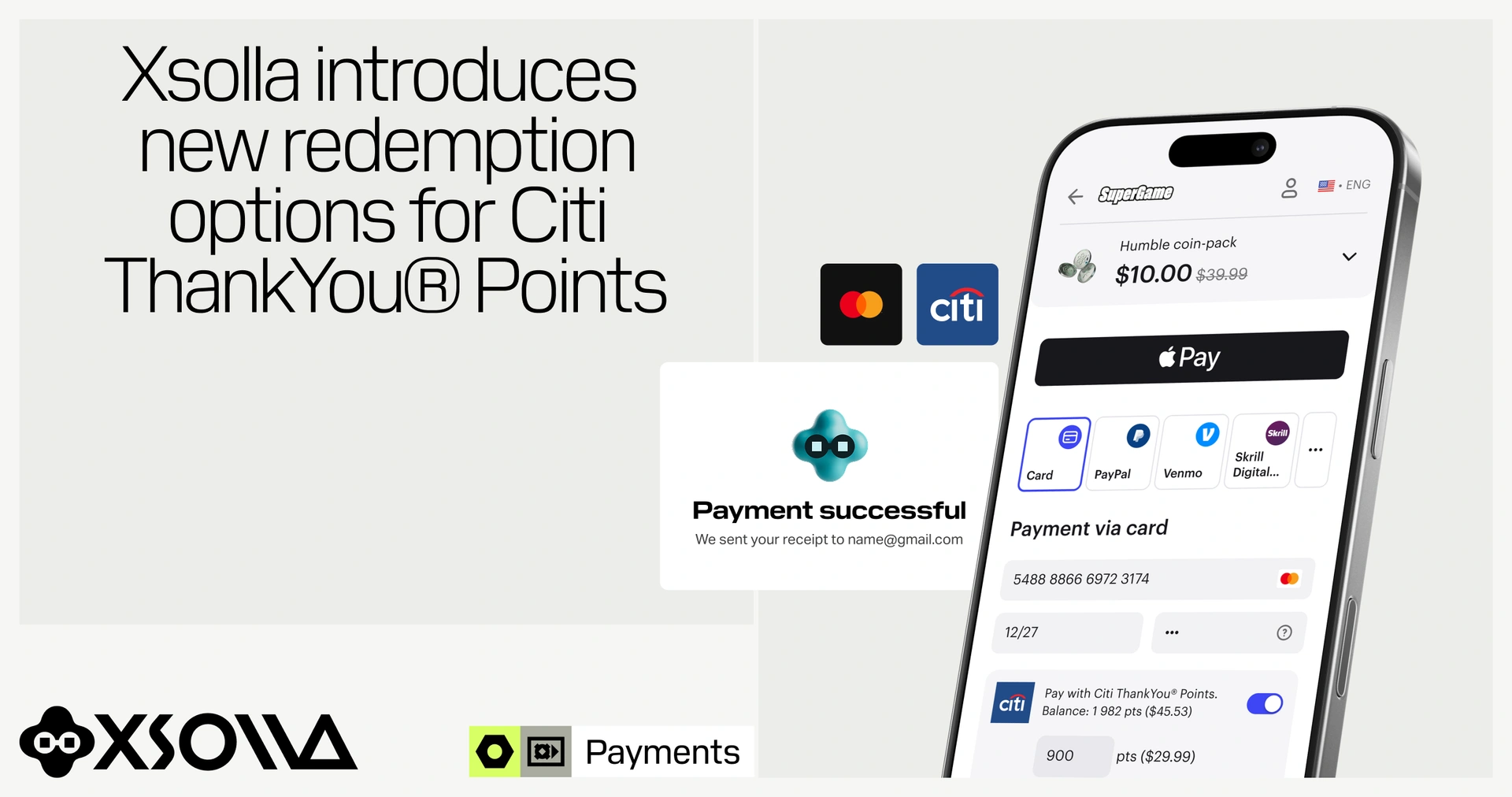
Eligible Citi Mastercard cardmembers can now use Citi ThankYou® Points on video games and in-game digital goods. Studios already using Xsolla Payments can offer points as a payment option without building or maintaining a separate loyalty integration.
How to solve the investment problem for mid-tier AA games
Shawn Layden is building a financing vehicle for stranded AA games. The teams keep their IP. The hard part is that nobody knows how to underwrite a video game.
Brian CrecenteEditorial consultant to the video game industry
SEPTEMBER 14, 20266 MIN
Proactive, not reactive: 24 years of keeping games online
The calm game launch is never luck; it's the result of work you do long before release day.
The players you already have are your biggest growth opportunity
Adikteev's Emilien Eychenne knows that your biggest game growth lever isn't new installs; it's learning to spot churn early and win mobile players back for good.
The trust gap: why Asian players abandon your checkout
Xsolla research across Asia reveals a consistent pattern: players do not abandon carts because of price; they leave because the checkout feels foreign. Here is what it takes to earn trust at the moment of purchase.
How game discovery actually works, and fails, in 2026
Distribution got democratized. Discoverability got concentrated. GAM3S.GG Head of Operations Eliza Crichton-Stuart speaks out on what that gap means for players and developers, and how to close it.
Virtual worlds were supposed to let players be themselves, but monetization forgets that
MUD1 co-creator Richard Bartle reflects on the origins of virtual worlds, the player-developer contract, free-to-play, pay-to-win, Web3, and why lasting MMOs need purpose before monetization.
Richard BartleGame Design Professor, University of Essex
AUGUST 13, 20266 MIN
What 15 years of game partnerships taught me
After 15 years and 170M downloads of Magic Jigsaw Puzzles, ZiMAD's Chief BD Officer shares how to protect player trust and lead through fast change.
GDAI's Program Director, Machaiah Kalengada, dives into the unique combination of India's 550 million young gamers and an industry ready to build its own IP. He reveals what's really happening in India's booming game development scene.
Andrew Naicker of Skystone Games has spent 14 years watching the "ship faster, market louder" playbook fail. Here's what he actually builds and what it takes to launch in 2026.
Entertainment licensing isn't a AAA-only game anymore. Xsolla Agency global IP licensing advisor Mark Caplan discusses how mobile studios are sitting on one of the best growth levers in the industry and most aren't using it. Here's what developers get wrong and how the right partner changes everything.
Mark CaplanGlobal IP licensing advisor, Xsolla Agency
AUGUST 13, 20269 MIN
The attention economy: how games win mind share in 2026
Players have more to watch, play, and scroll through than ever. They have less time to give any of it. Lexi Sydow, founder of The ATTN Economy, explains why that gap is the real battleground for every game in 2026.
Lexi SydowChief Analyst & Founder, The ATTN Economy
AUGUST 13, 20266 MIN
What keeps a game running for 24 years?
Sega's head of development studios on LiveOps, global growth, and going direct to players.
Are you a game industry expert with insights that inform? Help us grow Game Business Institute and earn revenue for contributions that have direct impact.
Game Biz Institute
The game industry's most extensive library of business insights.


-1920x1080.webp)



%20(1).png)
-1-400x400-400x400.webp)

-808x789.webp)
-1920x1080.webp)

-1920x1080.webp)

-1920x1072.webp)
-501x501.webp)

-500x500.webp)





-800x800.webp)

-2-1920x1920.webp)