
User engagement
Community
How the Right Customer Journey Helps You Acquire Paying Users
August 25, 2022•7 min
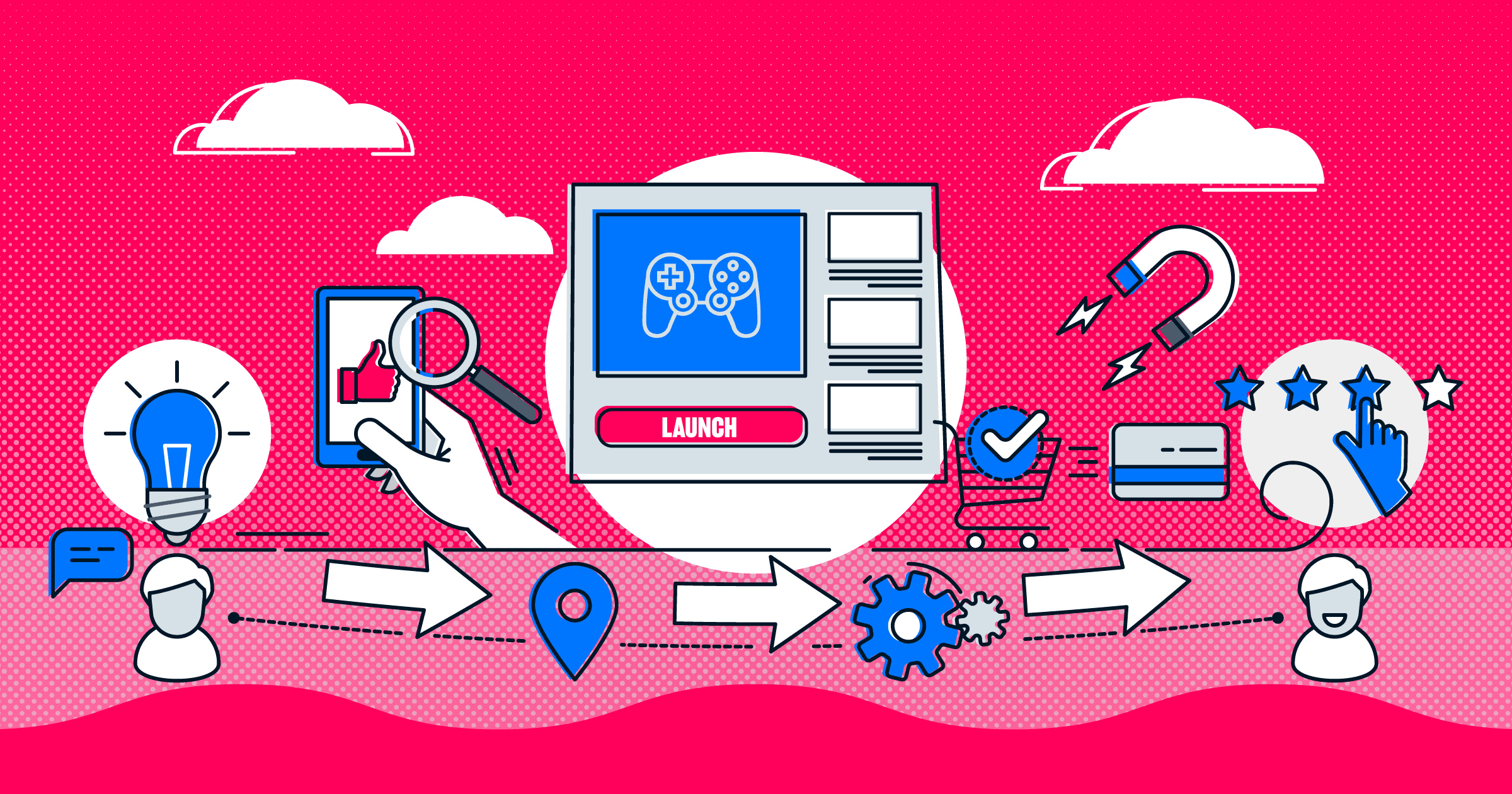
Whether you are designing, creating, or polishing an F2P or MMO game, many unexpected issues can test your limited development budget. At this stage, one of the most common causes of unforeseen expenditures is a poorly constructed user flow.
Players can often try F2P and MMO games without any initial investment, so the lifeblood for these types of games is in-game purchases. But often, in-game purchases don’t become available until players are fully onboarded and have spent some time playing. So to make sure that you have the highest chance of gaining a paying player, you need to ensure that the path to conversion — or “customer journey” — is as brief and uninhibited as possible.
Marketing helps, but it’s never a guarantee
As the budgets required to develop games like these have grown to new heights, it’s easy to see why studios spend more on user acquisition through marketing than ever before. And the growing proliferation of video game streamers and influencers has created more channels than ever through which a careful, wide-ranging marketing spend can garner the kind of attention your game needs.
 Overall spending on advertising within the gaming industry in the last decade.
One relevant example is the campaign for Cyberpunk 2077, where a strong, diverse cross-channel marketing campaign was a huge driver for community anticipation that translated to a high number of pre-sales. However, while this was successful for a premium AAA release, a marketing-focused user acquisition strategy only works for F2P and MMO games if the players you gain can be onboarded quickly and painlessly.
Why the customer journey matters
To better understand the value of a well-developed customer journey, let’s look at the financial implications of a poorly-developed customer journey.
First, let’s imagine that the player conversion rate for your game is 1%. This means that one of every 100 individuals who visit your game’s landing page will successfully register and launch the game.
Next, let’s then say that the cost for each player that visits your landing page is $1. By this logic, acquiring 100 new players will cost you $10,000.
Now let’s assume that of the 100 players that you acquire, 20 of them find your customer journey to be long, hard to follow, or unrefined in another way. As a result, your conversion rate drops to 0.8%. To make up this shortfall, you’ll need more visitors to successfully convert 100 players, which drives your cost up to $12.500.
By the same logic, if you aim to acquire 10,000 new players, it would originally cost you $1,000,000. But if the same customer journey issues are still at play, it will cost you an additional $250,000 to reach your goal. Plus, this is an idealized scenario — a real-life user acquisition strategy has many more factors that can affect its efficacy.
Additional costs for user acquisition due to a simple streamlining issue are not only self-inflicted but have a chance to cripple your game’s overall success. This money is better spent on marketing, live service costs, technical expenses, or other quality-of-life game improvements. However, if you don’t consider your game’s customer journey, you can unnecessarily forfeit these valuable resources.
Overall spending on advertising within the gaming industry in the last decade.
One relevant example is the campaign for Cyberpunk 2077, where a strong, diverse cross-channel marketing campaign was a huge driver for community anticipation that translated to a high number of pre-sales. However, while this was successful for a premium AAA release, a marketing-focused user acquisition strategy only works for F2P and MMO games if the players you gain can be onboarded quickly and painlessly.
Why the customer journey matters
To better understand the value of a well-developed customer journey, let’s look at the financial implications of a poorly-developed customer journey.
First, let’s imagine that the player conversion rate for your game is 1%. This means that one of every 100 individuals who visit your game’s landing page will successfully register and launch the game.
Next, let’s then say that the cost for each player that visits your landing page is $1. By this logic, acquiring 100 new players will cost you $10,000.
Now let’s assume that of the 100 players that you acquire, 20 of them find your customer journey to be long, hard to follow, or unrefined in another way. As a result, your conversion rate drops to 0.8%. To make up this shortfall, you’ll need more visitors to successfully convert 100 players, which drives your cost up to $12.500.
By the same logic, if you aim to acquire 10,000 new players, it would originally cost you $1,000,000. But if the same customer journey issues are still at play, it will cost you an additional $250,000 to reach your goal. Plus, this is an idealized scenario — a real-life user acquisition strategy has many more factors that can affect its efficacy.
Additional costs for user acquisition due to a simple streamlining issue are not only self-inflicted but have a chance to cripple your game’s overall success. This money is better spent on marketing, live service costs, technical expenses, or other quality-of-life game improvements. However, if you don’t consider your game’s customer journey, you can unnecessarily forfeit these valuable resources.
 Common customer journey issues
The shape and execution of your game’s ideal customer journey depends on a number of attributes, including its format, platform, genre, gameplay, and in-game economy. Applying a generic customer journey to your game seems like a timesaver, but it may feel disjointed or incomplete — which in turn can handicap your conversion rate.
It’s generally recommended that you test and adjust your customer journey to ensure that it’s streamlined, understandable, and syncs with your intended overall game experience. This way, you can prevent a significant loss in additional funds.
When optimizing your game’s customer journey, you may encounter several common pitfalls with the potential to frustrate potential players and drive them out of your conversion funnel. Issues like this to look out for include:
Common customer journey issues
The shape and execution of your game’s ideal customer journey depends on a number of attributes, including its format, platform, genre, gameplay, and in-game economy. Applying a generic customer journey to your game seems like a timesaver, but it may feel disjointed or incomplete — which in turn can handicap your conversion rate.
It’s generally recommended that you test and adjust your customer journey to ensure that it’s streamlined, understandable, and syncs with your intended overall game experience. This way, you can prevent a significant loss in additional funds.
When optimizing your game’s customer journey, you may encounter several common pitfalls with the potential to frustrate potential players and drive them out of your conversion funnel. Issues like this to look out for include:
 Next steps
Your ability to convert new players to paying players for your F2P or MMO game is perhaps the most critical element of your potential success. Your customer journey needs to be airtight, cost-effective, and align with your overall game experience.
Now that you understand how Xsolla Launcher can help you create and execute the ideal customer journey for your game, it’s time to take the next step.
If you’re not an Xsolla partner, contact us at [email protected] to learn about how we can help you maximize your player conversion rate with a custom launcher.
If you’re currently an Xsolla partner, email your account manager and set up a time to discuss how our expert team can help you turn more new players into paying players.
Next steps
Your ability to convert new players to paying players for your F2P or MMO game is perhaps the most critical element of your potential success. Your customer journey needs to be airtight, cost-effective, and align with your overall game experience.
Now that you understand how Xsolla Launcher can help you create and execute the ideal customer journey for your game, it’s time to take the next step.
If you’re not an Xsolla partner, contact us at [email protected] to learn about how we can help you maximize your player conversion rate with a custom launcher.
If you’re currently an Xsolla partner, email your account manager and set up a time to discuss how our expert team can help you turn more new players into paying players.
Overall spending on advertising within the gaming industry in the last decade.
One relevant example is the campaign for Cyberpunk 2077, where a strong, diverse cross-channel marketing campaign was a huge driver for community anticipation that translated to a high number of pre-sales. However, while this was successful for a premium AAA release, a marketing-focused user acquisition strategy only works for F2P and MMO games if the players you gain can be onboarded quickly and painlessly.
Why the customer journey matters
To better understand the value of a well-developed customer journey, let’s look at the financial implications of a poorly-developed customer journey.
First, let’s imagine that the player conversion rate for your game is 1%. This means that one of every 100 individuals who visit your game’s landing page will successfully register and launch the game.
Next, let’s then say that the cost for each player that visits your landing page is $1. By this logic, acquiring 100 new players will cost you $10,000.
Now let’s assume that of the 100 players that you acquire, 20 of them find your customer journey to be long, hard to follow, or unrefined in another way. As a result, your conversion rate drops to 0.8%. To make up this shortfall, you’ll need more visitors to successfully convert 100 players, which drives your cost up to $12.500.
By the same logic, if you aim to acquire 10,000 new players, it would originally cost you $1,000,000. But if the same customer journey issues are still at play, it will cost you an additional $250,000 to reach your goal. Plus, this is an idealized scenario — a real-life user acquisition strategy has many more factors that can affect its efficacy.
Additional costs for user acquisition due to a simple streamlining issue are not only self-inflicted but have a chance to cripple your game’s overall success. This money is better spent on marketing, live service costs, technical expenses, or other quality-of-life game improvements. However, if you don’t consider your game’s customer journey, you can unnecessarily forfeit these valuable resources.
Common customer journey issues
The shape and execution of your game’s ideal customer journey depends on a number of attributes, including its format, platform, genre, gameplay, and in-game economy. Applying a generic customer journey to your game seems like a timesaver, but it may feel disjointed or incomplete — which in turn can handicap your conversion rate.
It’s generally recommended that you test and adjust your customer journey to ensure that it’s streamlined, understandable, and syncs with your intended overall game experience. This way, you can prevent a significant loss in additional funds.
When optimizing your game’s customer journey, you may encounter several common pitfalls with the potential to frustrate potential players and drive them out of your conversion funnel. Issues like this to look out for include:
- If a player enters their authentication credentials, their expectation is that they are fully logged in from that point forward. Because of this, players can get frustrated if they have to enter login credentials multiple times.
- If a player registers through a launcher or within the game environment, it is irritating if they are required to exit to a browser to confirm their email address.
- Players can be discouraged if registration takes place via social media, but their authentication must take place in an external browser.
Next steps
Your ability to convert new players to paying players for your F2P or MMO game is perhaps the most critical element of your potential success. Your customer journey needs to be airtight, cost-effective, and align with your overall game experience.
Now that you understand how Xsolla Launcher can help you create and execute the ideal customer journey for your game, it’s time to take the next step.
If you’re not an Xsolla partner, contact us at [email protected] to learn about how we can help you maximize your player conversion rate with a custom launcher.
If you’re currently an Xsolla partner, email your account manager and set up a time to discuss how our expert team can help you turn more new players into paying players.Featured articles


Contact us
Talk to an expert
Ready to maximize revenue opportunities? Reach out to our experts and learn how to start earning more and spending less.